
Food Service & QSR Food Retail Food Production Pubs, Bars & Restaurants Hotels & Built Environment Cold Storage Commercial Buildings Data Centers Healthcare & Pharma Heavy Industry
Commercial restaurant kitchen in operation
Home  /  Sectors  /  Food Service & QSR
Food Service & Quick-Service Restaurants

Cut restaurant energy use up to 18.3%. Verified.

Emissis guarantees the payback period set out in your proposal — supported by formal M&V.

Installed around your service hours
Setpoints and food safety unchanged
Maintenance-free
kWh reduction validated by M&V
17.8%
Whole-site energy reduction
38.3%
Freezer energy reduction
31.4%
Kitchen HVAC reduction
24mo
Typical payback period · QSR
The Problem

Energy is one of your largest
controllable costs.

Restaurants use roughly five to seven times more energy per square foot than other commercial buildings, and a high-volume quick-service restaurant can reach ten times — according to ENERGY STAR. Refrigeration, HVAC and kitchen loads run from open to close, and often through the night. Most operators treat that as fixed overhead. It isn't.

❄️
Refrigeration runs around the clock
Walk-ins, prep fridges, and display units cycle their compressors continuously — even overnight. Compressors work far harder than they need to, wasting energy every hour of every day at every location in your estate.
Electrical waste you can't see
Kitchen motors, exhaust fans, HVAC units, and compressors create electrical noise that wastes energy across every circuit in your restaurant — invisibly, continuously, at scale.
📈
The savings potential is material at any scale
Whether you operate one location or thousands, the same verified technology applies. For multi-site operators, consistent per-location savings compound into a significant portfolio-wide outcome.
Energy use per square foot, relative to a typical commercial building Energy use per square foot Relative to a typical commercial building Typical commercial building Restaurant 5–7× High-volume QSR up to 10×
Source: ENERGY STAR, U.S. EPAEnergy Savings Tips for Small Businesses: Restaurants
What it is

The enPact family. Two devices, one approach.

You buy it once and you own it. Two patented devices — not a service, not a subscription, and not a share of your savings. They install onto the equipment you already have and keep working for as long as it runs. Which of the two you need depends on where the waste actually sits in your restaurant:
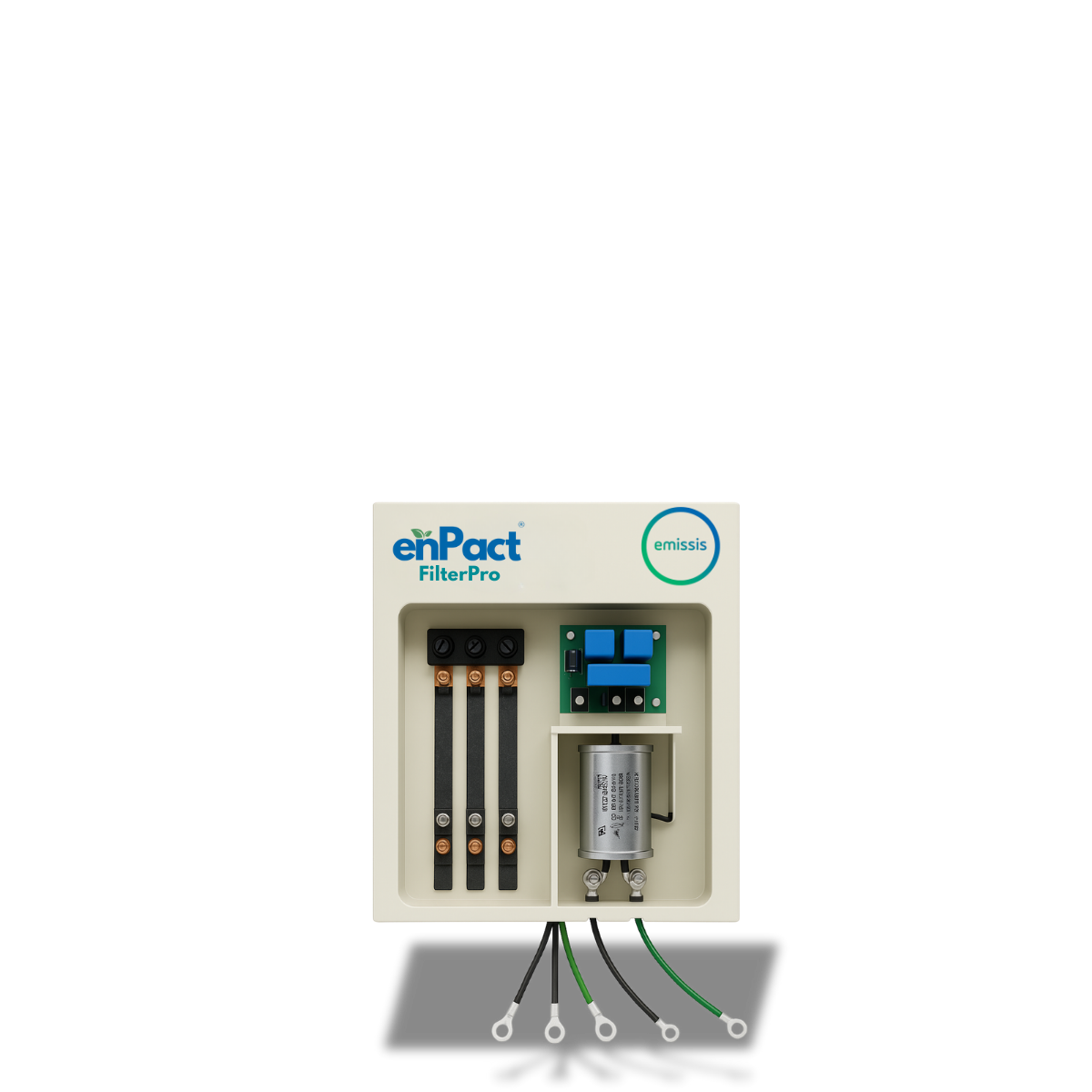
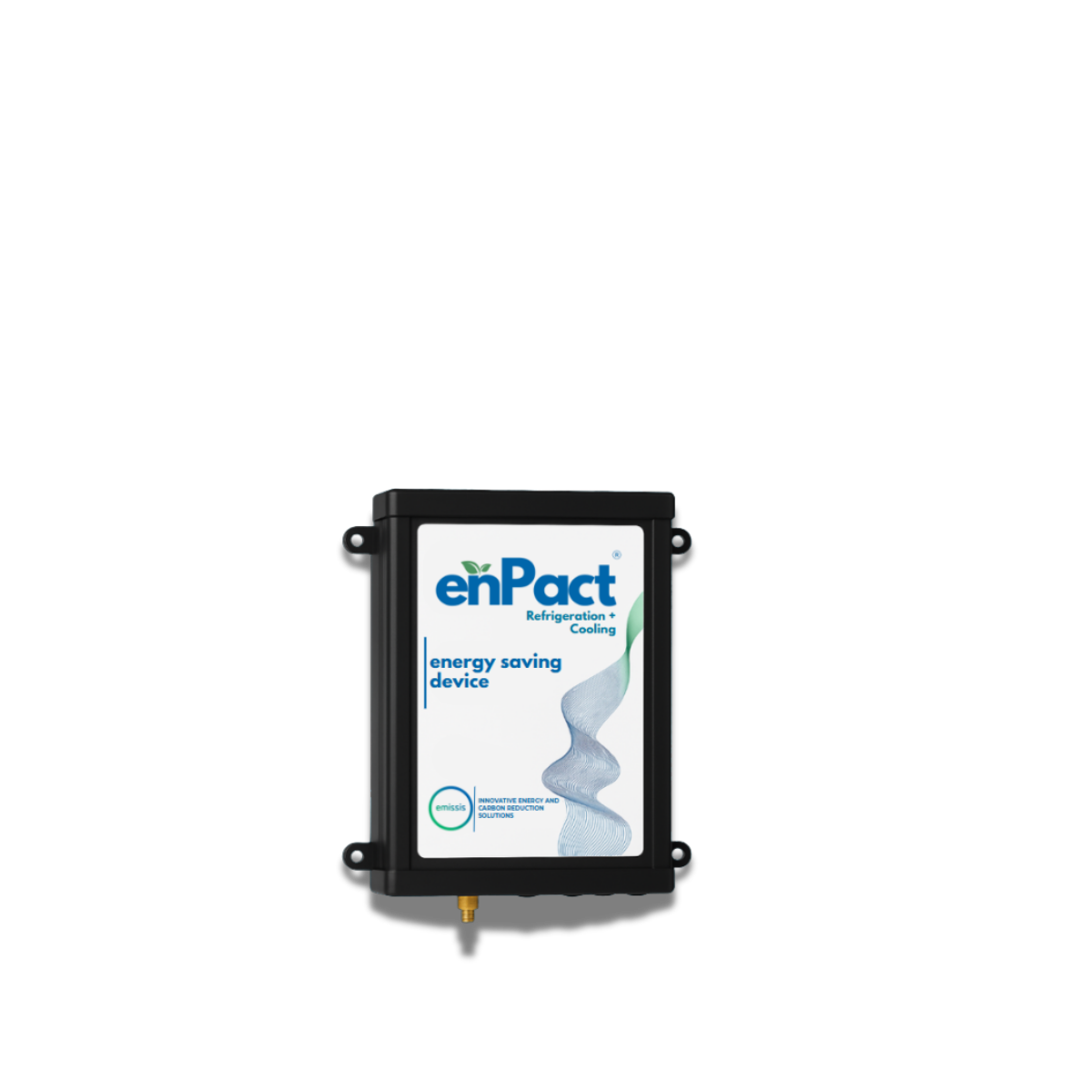
enPact FilterPro
At the main electrical panel — whole-site power quality across every circuit
enPact Refrigeration & Cooling
At each walk-in, freezer, prep unit and display case — deeper unit-level reduction
Both are capital purchases
A one-time purchase you own outright — no monthly fee, no share of the savings
enPact FilterPro device — installed at the main electrical panel
enPact FilterPro
At the panel
enPact Refrigeration & Cooling device — installed at individual refrigeration units
enPact R&C
At the unit
Where it sits

Connected at your panel. Felt across the restaurant.

FilterPro connects in parallel at your main electrical panel. It carries no load and conditions power quality at the source, so your refrigeration, HVAC, exhaust fans and kitchen equipment all draw cleaner power.

Refrigeration & Cooling installs at the individual unit — sensor-driven control at the evaporator trims compressor runtime on specific walk-in, freezer and cooling loads for a deeper reduction.

Your equipment sees cleaner power — and your refrigerant, setpoints, and controls stay exactly as they are.
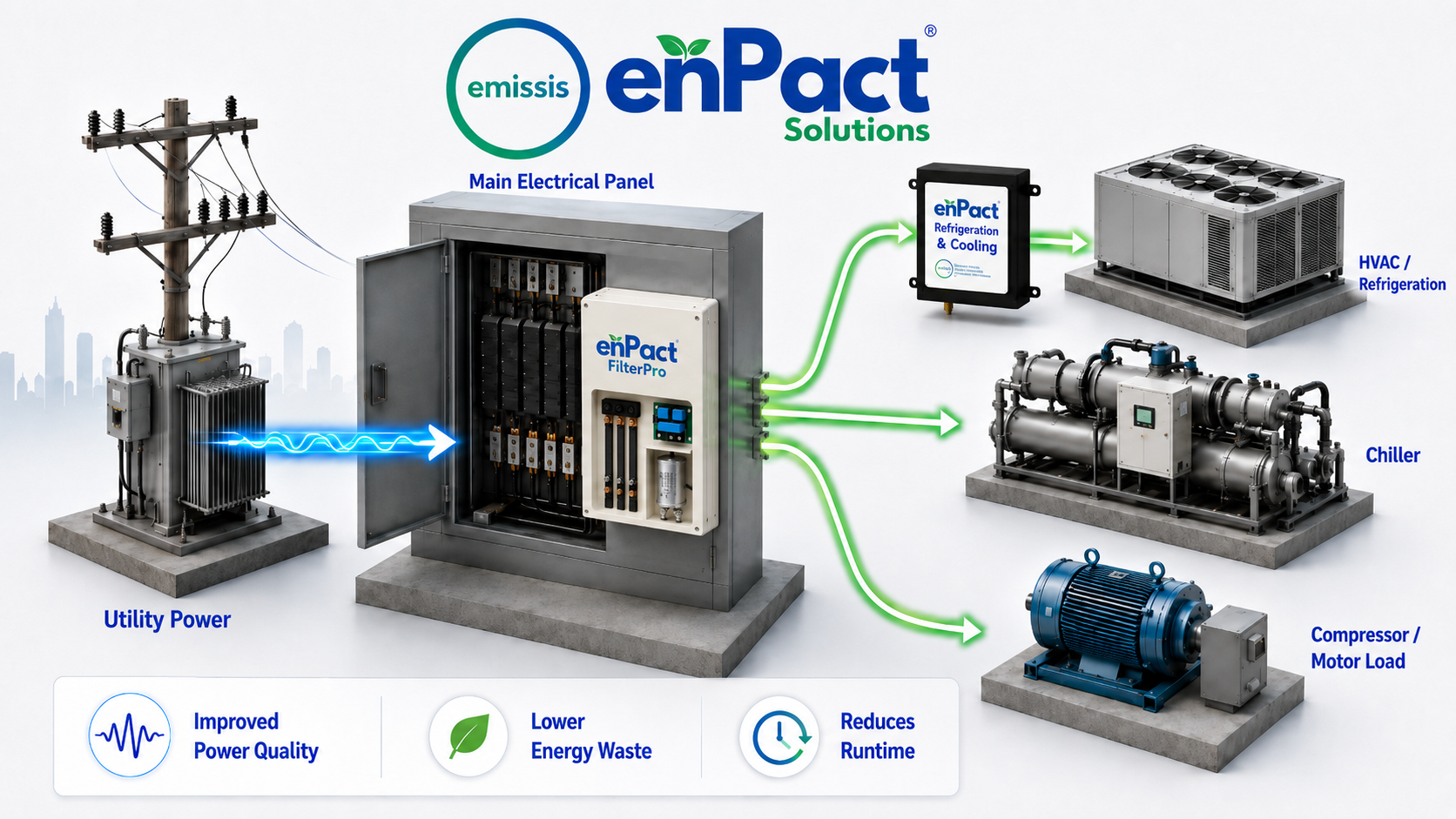
enPact integration diagram: utility power arrives at the main electrical panel where FilterPro connects in parallel, and power flows out to HVAC, cooling and compressor loads — with enPact Refrigeration & Cooling installed at the unit for deeper load-specific reduction
Why it works

Proprietary technology. Real reductions.

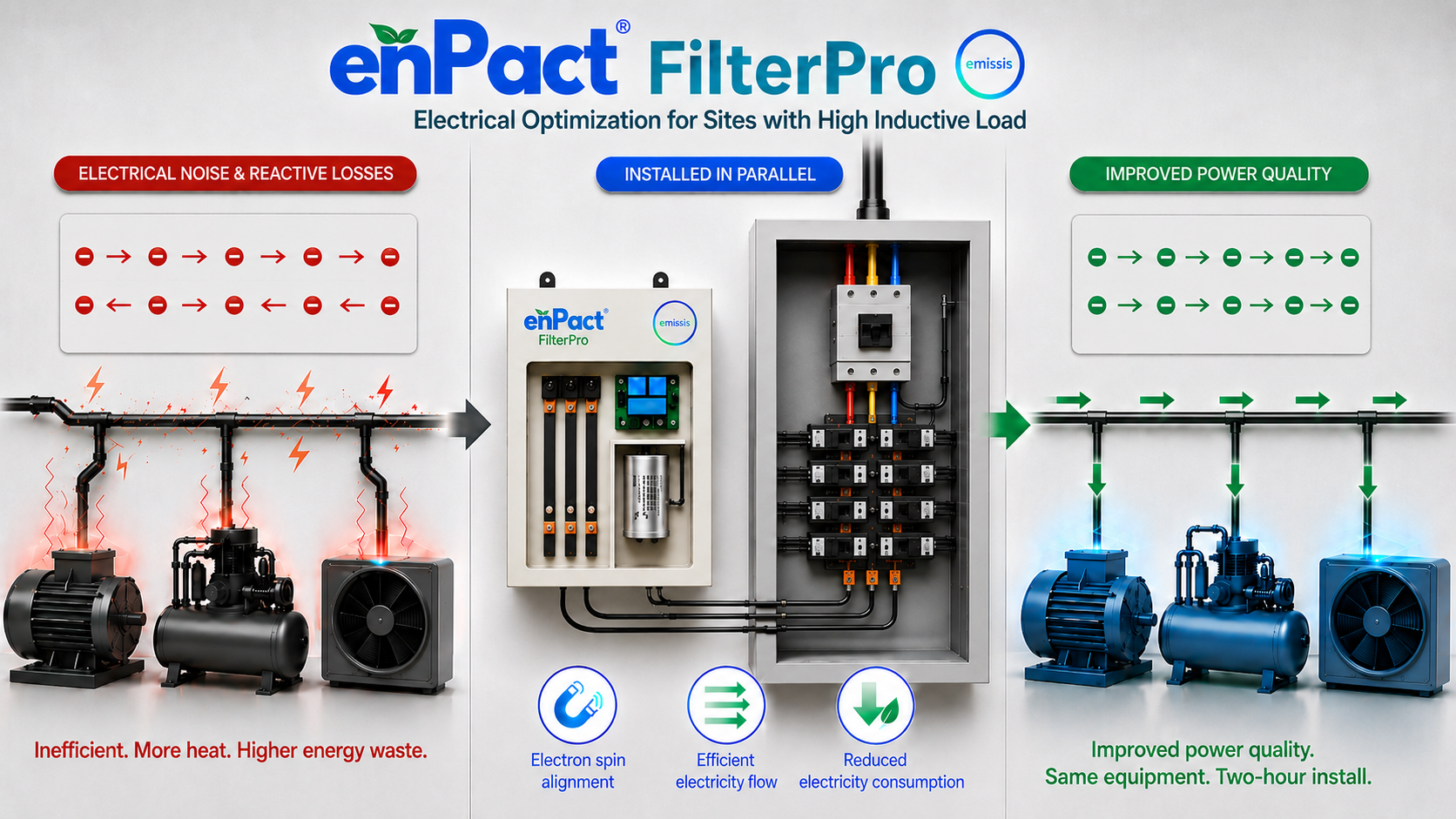
Motors and compressors draw more power than the work they do actually requires. The difference is lost to electrical noise and reactive losses before it ever reaches the equipment — it never shows as a fault, and it appears only on the bill.

That is what FilterPro addresses — it improves the quality of the supply reaching those loads. Refrigeration & Cooling works on a completely different mechanism, on the cooling side rather than the electrical one.
Installed around your hours
A brief power isolation to make the connection at the panel; equipment returns to service straight after
Nothing changes in the kitchen
Setpoints, refrigerant and OEM safety logic stay exactly as they are
Diagram: noisy, wasteful power feeding motors on the left; enPact FilterPro installed in parallel at the electrical panel in the middle; improved power quality reaching the same equipment on the right
How Refrigeration & Cooling actually works

The condensing unit is where 80–90% of a refrigeration system’s energy goes. Rather than throttling it, enPact watches for the moment the evaporator has done its job — then stops the compressor and lets the cold that is already in the coil do the rest.

1
Read the superheat
Two sensors track refrigerant temperature across the evaporator. Together they show the moment the evaporator reaches maximum cooling capacity.
2
Close the valve
At that point enPact interrupts the supply to the solenoid or expansion valve. The compressor stops — at peak efficiency, not at random.
3
Use what is already there
With the valve shut, the refrigerant still in the evaporator keeps cooling the space. You get the cooling without the compressor running for it.
4
Restart on demand
Once that refrigerant is spent and superheat drops to its lower threshold, the valve reopens and the compressor cycle resumes.

Note what is not in that sequence: your thermostat. Setpoints are never touched — enPact works off superheat and product temperature, so the box holds the temperature you set it to and stays HACCP-compliant. It is the compressor’s runtime that changes, not your cooling. Works with thermostatic and electronic expansion valves, alongside all major OEM equipment.

Why it matters

You buy it once. The savings keep coming.

Refrigeration and HVAC are among the largest controllable costs in a restaurant, and unlike rent or food cost they respond to engineering. Every kWh you stop drawing flows straight to your P&L, at every location, for as long as the equipment runs.

Most energy offers are a monthly fee or a cut of what you save, for years. This is a purchase. Your accountant will treat it as a capital asset rather than an operating expense — it goes on the balance sheet and depreciates, instead of hitting your P&L every month. In practice that means the savings are yours, all of them, from the first month onward. And the payback period is not a projection you are asked to trust — Emissis puts it in writing.

Yours, not rented
A purchase, not a monthly fee — your accountant books it as an asset, not an expense
Verified, not modelled
Savings measured and verified under an IPMVP-aligned methodology
Payback guaranteed in writing
If verified savings fall short of forecast, Emissis credits back capital to restore the quoted payback
How it is measured

Every site metered. Every claim verified.

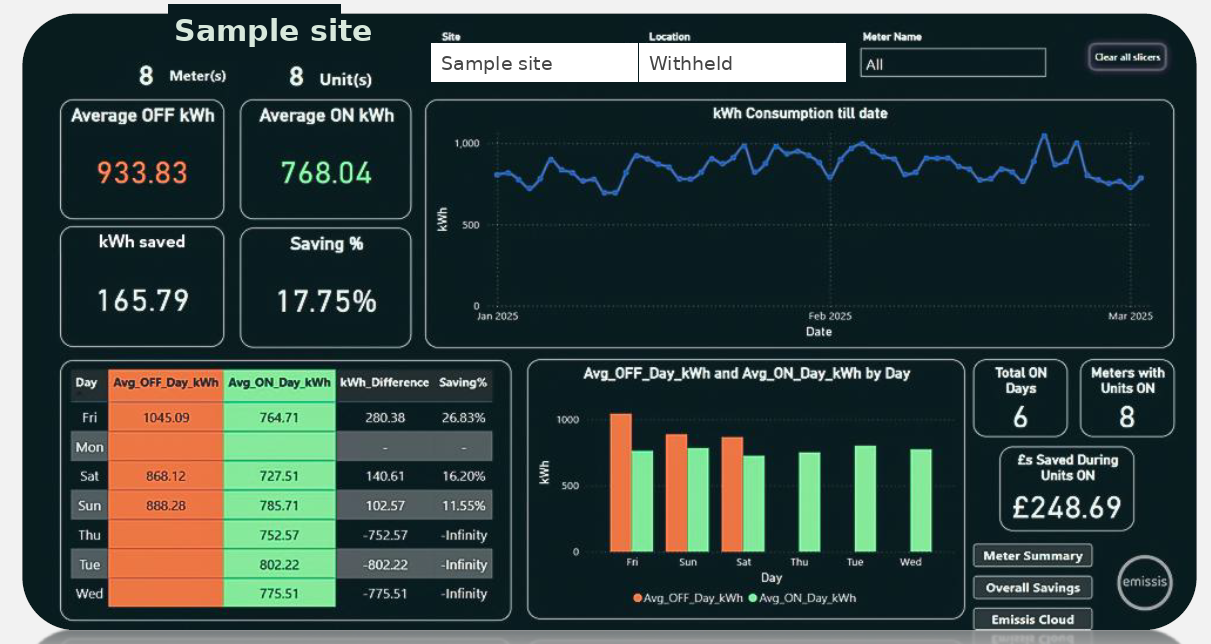
A savings figure nobody checks is a marketing number. Every enPact deployment is commissioned onto the Emissis monitoring platform, and the savings are measured against an internationally accepted methodology — IPMVP — validated for accuracy and bias. If you want to see how a savings figure was arrived at, the calculations behind it are open for you to inspect.
1
Baseline
A pre-installation survey establishes your baseline kWh and how the equipment actually performs under normal operating conditions — not nameplate ratings.
2
Forecast
Savings are modelled from your validated historical consumption, run-time analysis and equipment efficiency profiles. This is the figure the payback period is built on.
3
Monitoring
After install, consumption is collected through site meters, sub-metering or your energy management system — a like-for-like operational comparison, not a sample.
4
Verification
Actual performance is compared against baseline and normalised for outside factors such as weather and occupancy. Results are set out in a formal savings verification report.
5
Rebate
If verified savings come in below the forecast kWh, Emissis credits back the difference in capital cost needed to restore the payback period you were quoted.
Emissis monitoring platform dashboard showing metered consumption with the devices on and off, kWh saved, and percentage saving across a site
The monitoring platform, showing measured consumption with the devices on and off across one site. Sample data — site identity withheld.
Verified Results

Global fast-food chain.
Three locations. Verified results.

17.8%
Whole-site · U.S. Location 1
18.3%
Whole-site · U.S. Location 2
38.3%
Freezer reduction · U.S. Location 1
44.3%
Freezer reduction · U.S. Location 2
System · U.S. Location 1Reduction
Whole site (main incomer)17.8%
Freezer38.3%
Kitchen HVAC31.4%
Lobby HVAC37.6%
Washroom HVAC43.7%
IPMVP Verified — ON/OFF comparison · U.S. Location 1
Global Fast-Food Chain · U.S. & International Locations
"Savings verified across every major energy system simultaneously — freezer, HVAC, and kitchen — with no disruption to operations."

enPact Refrigeration & Cooling was deployed across three locations — two in the U.S. and one in Ireland — covering freezers, coolers, and HVAC systems. Results were measured using ON/OFF comparison periods across each individual system to produce clean, defensible savings data.

Location 1 (U.S.): 17.8% whole-site reduction, with every major system showing significant improvement — freezer down 38.3%, kitchen HVAC down 31.4%, and lobby HVAC down 37.6%. Location 2 (U.S.): 18.3% whole-site result, with the freezer alone reducing by 44.3% and the cooler by 46.6%.

The consistency across three different locations — different countries, different site profiles — demonstrates that these results are repeatable, not site-specific anomalies.

U.S. Location 2 — supporting result
18.3%
Whole-site reduction
44.3%
Freezer reduction
46.6%
Cooler reduction

See what your locations
could save this year.

Send us twelve months of utility data and we will come back with a site-specific review. No estimate goes out before the numbers are in.

Book a 30-min Call →
Or have us reach out

Tell us a little about your operation and we will follow up with material relevant to your equipment — not a generic brochure.

Thanks — that’s with me. I’ll send the QSR results one-pager over within two business days, along with anything specific to the systems you listed.
Please enter your first name.
Please enter your last name.
Please enter a valid email address.
Please enter your company.
Please enter your role.
Please add a short description, or untick the box.
We use this only to respond to your enquiry. No list, no newsletter.